How to Play American Mahjong: Rules for Beginners, Step by Step
American Mahjong is a game for four players using 152 tiles, including 8 jokers, and a card of winning hands that changes every year. To play, you pick a hand from the card, trade unwanted tiles in a passing round called the Charleston, then draw and discard one tile per turn. The first player whose 14 tiles match a hand on the card calls "Mahjong" and wins.
The steps below follow the order of play at the table.
The game at a glance
| American Mahjong | |
|---|---|
| Players | 4 (some tables play with 3) |
| Tiles | 152, including 8 jokers and 8 flowers |
| Tiles in your hand | 13 during play, 14 to win |
| Winning hands | Only the hands printed on this year's card |
| Wild tiles | Jokers, in groups of 3 or more only |
| Before play starts | The Charleston, a round of passing tiles |
| Time per hand | About 10 to 20 minutes |
What you need
You need a 152-tile American set, one copy of this year's card for each player, four racks, and two dice. The card is published each spring by the National Mah Jongg League, and every hand you can win with is on it. Groups buy a new card every year. (What you need to play.)
The tiles come in three suits (bams, cracks and dots), plus winds, dragons, flowers and jokers:
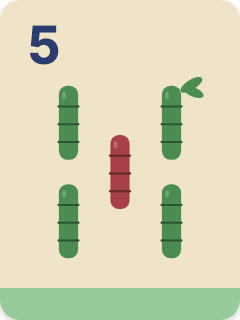






Our tile guide has the full chart, with how many of each tile are in a set.
Step 1: Build the wall and deal
Turn all the tiles face down and mix them. Each player builds a wall in front of their rack, 19 stacks long and two tiles high. Push the four walls together into a square.
One player is East, the dealer. East rolls the dice to decide where to break the wall, and players take tiles from the break in turn. When the deal is done, East has 14 tiles and everyone else has 13. Stand your tiles on your rack so only you can see them.
Step 2: Pick a hand from the card
Every line on the card is one complete winning hand of exactly 14 tiles. The lines are grouped into families, such as even numbers (2, 4, 6, 8), odd numbers, runs of consecutive numbers, like numbers, winds and dragons, and hands built on this year's date.
Look at your tiles and find one or two lines you are closest to. You don't have to commit yet. The Charleston will push you one way or another.
To make that concrete, here is a made-up hand in the style of the even-number family. It is our own example, not a line from any card: three 2s, four 4s, four 6s and three 8s, all in one suit.
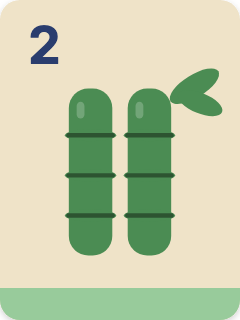
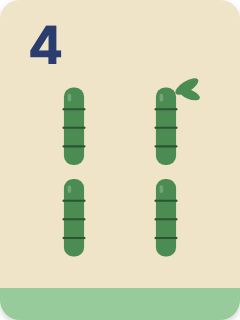
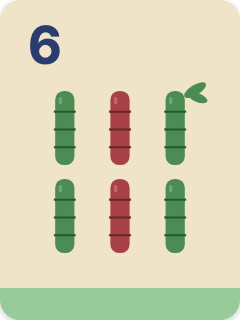
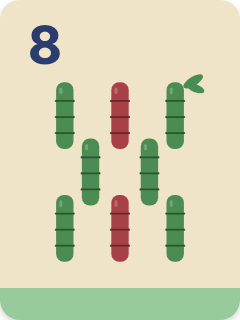
The card uses colors to show suits and letters for special tiles. Our guide to reading the card explains every mark.
Step 3: Do the Charleston
Before anyone plays, everyone passes tiles they don't want. Each pass is three tiles.
- Pass three tiles to the player on your right.
- Pass three tiles to the player across from you.
- Pass three tiles to the player on your left.
If every player agrees, there is a second Charleston in the other direction: left, across, right. Any one player can stop it. Then the two players across from each other may make a courtesy pass of zero to three tiles, the same number each way.
You may never pass a joker. On the last pass of each Charleston you may pass tiles along without looking at them, called a blind pass. (The full Charleston guide.)
Step 4: Draw and discard
East starts by discarding one tile, since East already holds 14. After that, each turn has two parts:
- Draw the next tile from the wall.
- Discard one tile face up in the middle of the table, and say its name out loud, such as "3 dot" or "north."
Turns go to the right. Your hand stays at 13 tiles between turns. Each draw and discard nudges your hand closer to a line on the card.
Step 5: Call discards to expose groups
When another player discards a tile you need, you can call it, even if it isn't your turn. You may call a discard for two reasons only:
- It completes a group of three or more matching tiles: a pung (3), kong (4) or quint (5). You set that group face up on top of your rack. This is called an exposure. Then you discard, and play continues to your right.
- It is the last tile you need to win.
You can't call a tile to make a pair, unless that pair wins the game. And if the hand you are building is marked concealed on the card, you can only call the final tile for Mahjong.
If two players call the same tile, the player calling it for Mahjong gets it. If both want it for the same reason, the one whose turn comes first gets it. Once the next player draws and racks a tile, or discards, the tile can no longer be called. (More on calling discards.)
Step 6: Use jokers
Jokers are wild. A joker can stand in for any tile in a pung, kong or quint. It can never be a single tile or part of a pair.

That is a legal pung of 7 dots. The same joker could not make a pair of 7 dots.
When a joker sits in an exposure on the table and you hold the real tile it stands for, you may swap your tile for the joker on your turn. This is the joker exchange. (All the joker rules.)
Step 7: Call Mahjong
When your 14 tiles match one hand on the card exactly, say "Mahjong" and lay your whole hand face up. The other players check it against the card. You can win on a tile you draw or on a discard you call.
If the wall runs out and nobody has won, the hand is a wall game. Nobody pays, the tiles are mixed, and the next hand begins. The deal passes to the right after every hand.
A player can also be declared dead during a hand, for example when their exposures can no longer make any hand on the card. A dead player stops drawing and discarding but still pays the winner. (Dead hands, explained.)
Step 8: Settle up
Every hand on the card shows a point value, usually 25 or more. How much each player pays depends on how the winner got the last tile:
| How the hand was won | Player who discarded it | Each other player |
|---|---|---|
| Called someone's discard | 2 × value | 1 × value |
| Drew the tile from the wall | (no discarder) | 2 × value |
A hand made with no jokers at all pays double again, except for singles and pairs hands, which can't use jokers anyway. Many groups play for coins or keep score on paper. The math is the same. (Scoring, with worked examples.)
Words you'll hear at the table
- Pung, kong, quint: three, four or five identical tiles.
- Exposure: a group you called and set face up on your rack.
- Concealed: a hand built entirely in your rack, with no exposures.
- Soap: the white dragon. On the card it also works as a zero.
- Hot tile: a tile that looks likely to give another player Mahjong.
Our glossary defines more than 40 terms, a sentence or two each.
How long does it take to learn?
Most people can play a slow, friendly game after one lesson and a few practice hands. Reading the card quickly takes a few weeks of regular play. After that, the game is strategy: which hand to pick and which tiles are safe to throw.
Practice one hand a day
The fastest way to learn is to play real hands. Our free daily hand gives you one full game a day, with the Charleston, calls and jokers, played against computer players. Everyone gets the same deal, so you can compare how you did with friends.
Frequently asked questions
- How do you play American Mahjong for beginners?
- Pick a hand from this year's card, pass unwanted tiles in the Charleston, then draw and discard one tile per turn. You can call other players' discards to complete groups of three or more. The first player whose 14 tiles match a hand on the card calls Mahjong and wins.
- How many tiles does each player get in American Mahjong?
- Each player starts with 13 tiles. East, the dealer, starts with 14 and discards first. A winning hand is always 14 tiles.
- What is the difference between American Mahjong and other mahjong?
- American Mahjong uses 152 tiles including 8 jokers, starts each hand with the Charleston, and only allows the winning hands printed on a card that changes every year. Chinese Official and Japanese Riichi mahjong, for example, have no jokers, no Charleston and no yearly card.
- Can you play American Mahjong with 3 players?
- Yes. Many groups play with three when a fourth can't come. Tables adjust the Charleston for three, most often by skipping the across pass. Agree on the change before you start. Four is the standard game.
- Which way does play go in American Mahjong?
- Turns go to the right. After each hand, the deal also passes to the right, so a new player becomes East.
- Do you need the card to play American Mahjong?
- Yes. You can only win with a hand printed on the current year's card, so every player needs a copy. The National Mah Jongg League publishes a new card each spring.
No signup needed. New to the game? Start with June’s free lessons.